What Is Rust and Why Is It Worth Learning for Beginners?
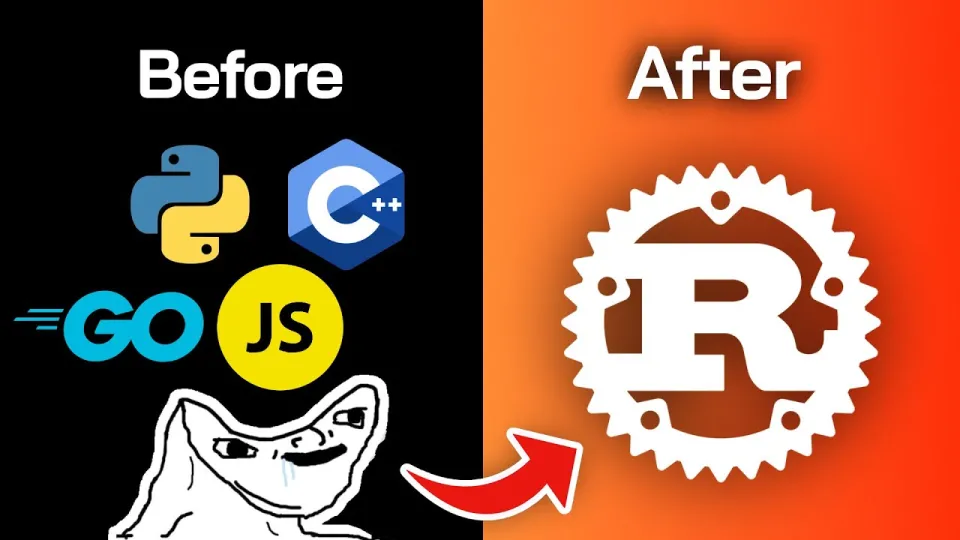
Video: Rust for Dummies in 12 Minutes
You can order the same kind of articles for your own video to boost it on YouTube and Google. Just message the Telegram bot @sat_sit_bot. Articles with your video embedded are written and posted by the bot itself — on popular topical sites (no ads). Try it free: 50 articles on us.
Key takeaways
- Rust is a compiled systems language that enforces memory safety at compile time through ownership and borrowing instead of a garbage collector.
- A value has exactly one owner; when that owner goes out of scope, the memory is freed automatically, so there is no manual free() call.
- Borrowing rules allow many immutable references or one mutable reference at a time, which prevents data races and use-after-free bugs.
- Rust's type system uses enums and pattern matching, such as Option and Result, to make missing values and errors explicit.
- The Let's Get Rusty breakdown covers the language in roughly 12 minutes across two parts: why Rust code doesn't break, and the type system.
Rust is a compiled systems programming language that guarantees memory safety without a garbage collector by checking ownership and borrowing rules at compile time. Instead of tracking down crashes at runtime, a Rust developer gets a compiler error before the program ever runs. The Let's Get Rusty breakdown of Rust in about 12 minutes makes the case that the language is not as hard as its reputation suggests, and you can grab the free Rust Job-Ready Roadmap by joining the Rust Live Accelerator waitlist.
Why does Rust code not break at runtime?
Rust prevents most crash-causing bugs by making memory management a compile-time contract rather than a runtime hope. In languages with manual memory management, the programmer allocates memory and must remember to release it; forgetting causes leaks, and releasing twice or using a pointer after release causes corruption. Rust replaces that discipline with a set of rules the compiler enforces for you.
The central rule is ownership: every value has exactly one owner, and when that owner goes out of scope, the value is dropped and its memory is freed automatically. There is no `free()` call to forget, and no garbage collector pausing the program to clean up. The compiler inserts the cleanup for you at the end of the owner's lifetime.
A second rule covers borrowing. You can hand out references to a value instead of moving it, but the compiler restricts how: any number of immutable references, or exactly one mutable reference, never both at once. That single constraint eliminates data races and iterator invalidation in safe code, because no one can mutate a value while someone else is reading it.
A third rule is lifetimes, which tie a reference to the data it points at so a dangling reference cannot escape. In practice, the compiler infers most lifetimes, and you only write them explicitly when a function returns a reference and the compiler needs to know which input it came from.
The payoff is that whole categories of bugs — use-after-free, double free, null dereference in safe code, data races — become compile errors. The trade-off is a steeper learning curve early on, because the borrow checker rejects programs that would work fine in other languages until you restructure them to express ownership clearly.
What makes Rust's type system different?
Rust's type system turns implicit assumptions into explicit, checked values. The most visible example is the absence of null: instead of a value that may secretly be nothing, Rust uses the `Option<T>` enum, which is either `Some(value)` or `None`. The compiler forces you to handle the `None` case before you can use the inner value, so null-pointer crashes simply cannot occur in safe Rust code.
Errors work the same way through `Result<T, E>`, which is either `Ok(value)` or `Err(error)`. There are no hidden exceptions propagating up the call stack; a function that can fail says so in its signature, and callers must decide what to do. Pattern matching with `match` lets you handle every variant in one place, and the compiler warns you if you miss one.
Rust also enforces strict typing at the language level. Where JavaScript's loose equality can silently coerce a string into a number, Rust has no implicit conversions between types — comparing or assigning mismatched types is a compile error, not a surprise at runtime. Newtypes, traits and generics build on this to let you encode business rules in the type system itself, so invalid states are unrepresentable.
How does Rust compare with C++, Java and JavaScript?
Rust's closest competitor on performance and control is C++, but the safety model differs sharply. Modern C++ offers smart pointers such as `unique_ptr` and `shared_ptr` that free memory when they go out of scope, which is conceptually similar to Rust's ownership. The difference is enforcement: in C++ these are conventions a team may or may not follow, while in Rust the compiler rejects code that violates the rules, including in third-party dependencies.
Against Java and other garbage-collected languages, Rust trades automatic memory reclamation at runtime for automatic reclamation at compile time. You get predictable performance without collector pauses, at the cost of thinking about ownership up front. Against JavaScript, the gap is even wider: no runtime type coercion, no implicit nulls, and a compiler that catches type mistakes before deployment.
The practical consequence is that Rust is common in places where crashes are expensive — command-line tools, network services, embedded systems, WebAssembly modules and parts of operating system kernels. Many developers arrive at Rust not out of enthusiasm for the syntax but because the projects they rely on are written in it and they want to contribute.
What should a beginner learn first in Rust?
Start with ownership and borrowing before anything else, because every later concept depends on them. A workable order looks like this:
- Install the toolchain with `rustup`, then create a project with `cargo new` and run it with `cargo run`.
- Learn variables, mutability (`let` versus `let mut`), functions, and the basic scalar and compound types.
- Work through ownership: moves, clones, references, and when the compiler rejects a borrow.
- Learn `struct`, `enum`, `impl` blocks and pattern matching with `match`.
- Study `Option` and `Result`, plus the `?` operator for propagating errors.
- Move on to traits, generics and lifetimes, then collections such as `Vec` and `HashMap`.
The single most useful habit is reading compiler errors carefully. Rust's diagnostics usually name the exact problem, point at both conflicting borrows, and often suggest a fix such as adding `mut`, cloning, or restructuring to shorten a borrow's scope. Beginners who treat the borrow checker as a teacher rather than an obstacle progress much faster.
Common doubts about learning Rust
A frequent concern is that Rust is only for low-level work and offers nothing for application developers. In practice, the ecosystem covers web servers, command-line utilities, data processing and WebAssembly, and the same safety guarantees apply everywhere.
Another common doubt is whether the borrow checker ever stops fighting you. It does: most experienced Rust developers report that after a few weeks the rules become intuition, and the compiler's objections start to feel like early bug reports rather than obstacles. The initial friction is real, but it is concentrated in the first phase of learning.
A third question is whether Rust replaces C++ entirely. It does not; existing C++ codebases with mature smart-pointer discipline remain safe and productive, and Rust is typically adopted for new components, tools and services where compile-time guarantees pay off immediately. Comparisons that ignore modern C++ practices overstate the contrast, but the enforcement gap is genuine.
Where to go next with Rust
The fastest route from syntax to employable skill is building something real: a CLI tool, a small HTTP service, or a parser, each of which forces you to confront ownership, error handling and traits in context. Pair that with reading the official book and the standard library documentation for the types you use most.
The 12-minute breakdown from the Let's Get Rusty channel is a good orientation before that deeper work, because it frames Rust as a set of guarantees rather than a pile of syntax. When you are ready to go further, the Rust Live Accelerator waitlist includes a free Rust Job-Ready Roadmap covering the skills and projects employers look for.
Questions & answers
Is Rust actually hard to learn for a beginner?
The syntax itself is approachable; the difficulty is the ownership and borrowing model, which differs from what most developers already know. Expect a few weeks of friction while the compiler rejects code that would run in other languages. After that, the rules become intuitive and the compiler starts to feel like a helpful reviewer rather than an obstacle.
Do I need to know C or C++ before learning Rust?
No. Rust is self-contained, and the concepts it borrows from systems programming — stack versus heap, pointers, memory layout — are explained in its own learning materials. Prior C or C++ experience helps with low-level intuition, but developers coming from Java, Python or JavaScript learn Rust successfully every day.
Does Rust have a garbage collector?
No. Rust frees memory deterministically when a value's owner goes out of scope, which the compiler arranges at compile time. That gives you memory safety without runtime collection pauses, which is one reason Rust is used for performance-sensitive tools and services.
Can Rust code still crash or have bugs?
Yes. Rust eliminates memory-safety bugs in safe code, but logic errors, panics from explicit calls, and bugs inside unsafe blocks are still possible. The guarantee is narrower than 'no bugs': it is that a whole class of crashes and data races cannot compile.